
As an important part of photovoltaic power station, photovoltaic bracket carries the main body of power generation of photovoltaic power station. The choice of bracket directly affects the operational safety, damage rate and construction investment of photovoltaic modules. Choosing a suitable photovoltaic bracket can not only reduce the project cost, but also reduce the subsequent maintenance cost.
Photovoltaic bracket type
1. Classification according to materials
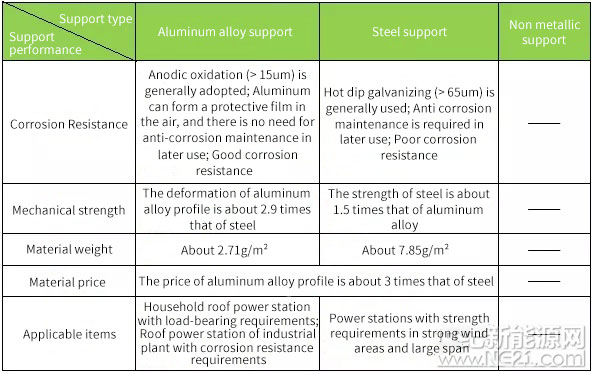
According to the different materials used for the main force-bearing members of photovoltaic supports, they can be divided into aluminum alloy supports, steel supports and non-metallic supports. Among them, non-metallic supports are less used, while aluminum alloy supports and steel supports have their own characteristics.
2. Classification according to installation method
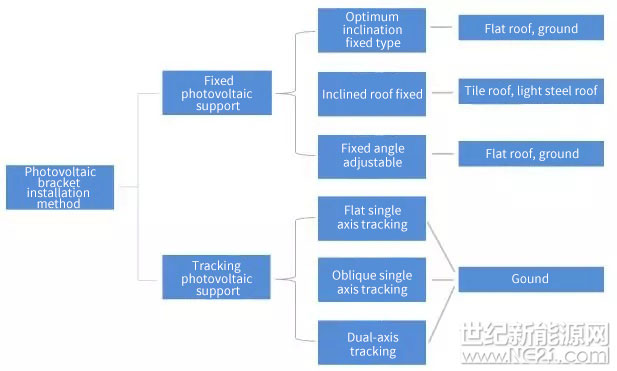
Introduction of fixed photovoltaic bracket
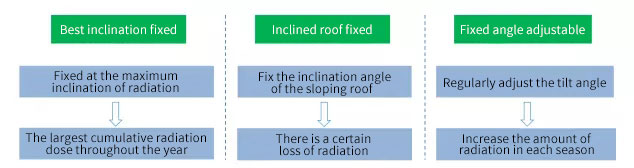
The photovoltaic array does not rotate with the change of the sun's incident angle, and receives solar radiation in a fixed manner. According to the setting of the inclination angle, it can be divided into: the best inclination angle fixed type, the inclined roof fixed type and the inclination angle adjustable fixed type.
1. The best inclination angle is fixed
The best local installation inclination is calculated first, and then all arrays are fixedly installed at this inclination. Currently, it is widely used in flat roof power stations and ground power stations.
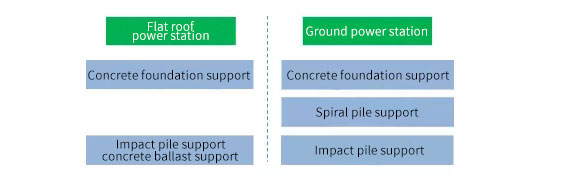
1) Flat roof-concrete foundation bracket
Flat roof concrete foundation support is currently the most commonly used installation form in flat roof power stations. According to the form of foundation, it can be divided into strip foundation and independent foundation; the connection between the support column and the foundation can be connected by anchor bolts or directly supported The columns are embedded in the concrete foundation.
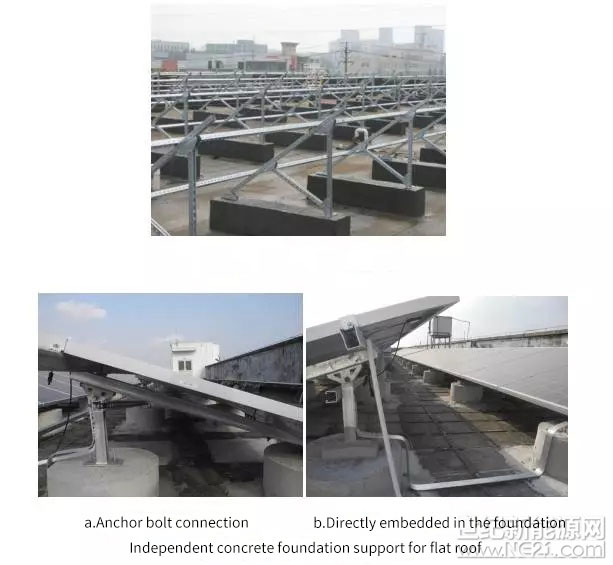
Advantages: good wind resistance, strong reliability, and no damage to the roof waterproof structure.
Disadvantages: The concrete foundation needs to be made first and cured to sufficient strength before subsequent bracket installation can be carried out. The construction period is long.
2) Flat roof-concrete ballast bracket
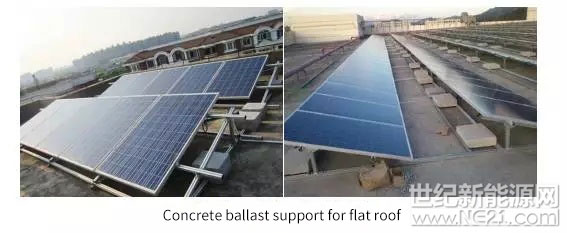
Advantages: The construction method of the concrete ballast support is simple, and the support can be installed at the same time when the counterweight is made, saving construction time.
Disadvantages: The concrete ballast support has relatively poor wind resistance, and the weight of the counterweight needs to be fully considered when designing the weight of the local maximum wind.
3) Ground power station-concrete foundation support
There are many kinds of concrete foundation brackets for ground power stations. According to the geological conditions of the unused project, the corresponding installation method can be selected. The following mainly introduces the most common types of cast-in-place reinforced concrete foundations, independent and strip concrete foundations, and precast concrete hollow column foundations. Concrete foundation installation form.
Cast in situ reinforced concrete foundation
According to different foundation forms, cast-in-place reinforced concrete foundations can be divided into cast-in-place concrete piles and cast anchor rods.
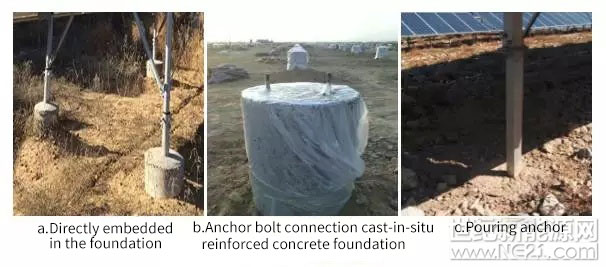
Advantages: less earthwork for cast-in-place reinforced concrete foundation excavation, small amount of concrete steel bars, low cost and fast construction speed.
Disadvantages: The construction of cast-in-place reinforced concrete foundation is easily restricted by environmental factors such as seasons and weather, and the construction requirements are high. Once completed, it cannot be adjusted.
Independent and strip concrete foundation
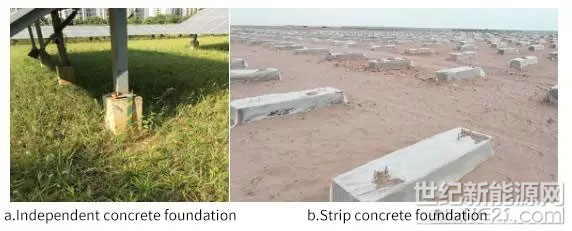
Advantages: independent and strip-shaped concrete foundation adopts reinforced expanded foundation, simple construction method, strong geological adaptability, and the embedded depth of the foundation can be relatively shallow.
Disadvantages: The independent and strip concrete foundation has a large amount of work, requires a lot of labor, a large amount of earth excavation and backfilling, a long construction period, and great damage to the environment.
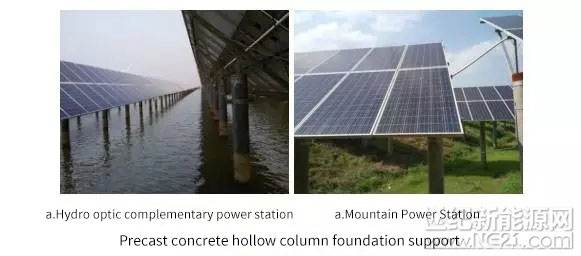
Precast concrete hollow column foundation
Precast concrete hollow column foundations are widely used in power stations with poor geological conditions such as hydro-optical complementary power stations and tidal flat power stations. At the same time, due to the advantages of the foundation height, it is also used in mountain power stations and agricultural complementary power stations.
4) Ground power station-metal pile bracket
Metal pile supports are also widely used in ground power stations, and can be divided into spiral pile foundation supports and impact pile foundation supports.
Screw pile foundation support
Spiral pile supports can be divided into spiral pile supports with flanges and spiral pile supports without Faraday discs according to whether they have flanges or not; according to the shape of cotyledons, they can be divided into narrow-leaf continuous spiral pile supports and wide-leaf interval spiral pile supports.
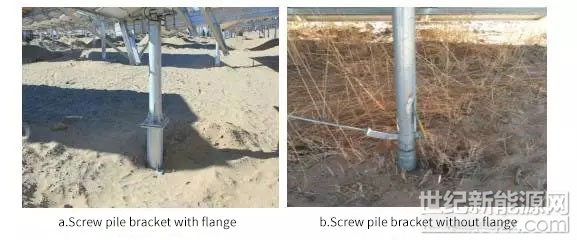
Screw piles with flanges can be used for single-column installation or double-column installation, while screw piles without flanges are generally only used for double-column installation.
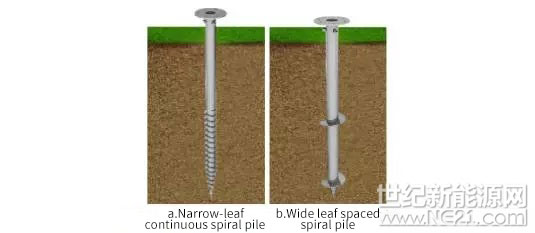
The pull-out resistance of the wide-leaf spaced spiral pile support is better than that of the narrow-leaf continuous spiral pile support. In areas with high winds, the wide-leaf spaced spiral pile support should be given priority.
Impact pile foundation support
Impact pile foundation support, also called metal fiber pole foundation support, is mainly used to directly drive C-shaped steel, H-shaped steel or other structural steel into the ground with a pile driver. This installation method is very simple, but the pull-out resistance is poor.
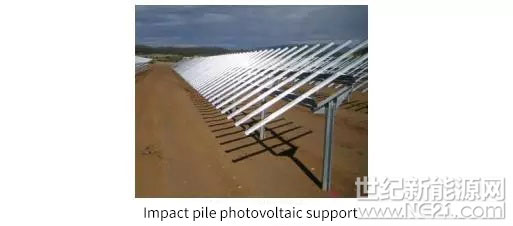
Advantages: For metal pile foundations, steel piles are driven into the soil with a pile driver, no need to excavate the ground, and it is more environmentally friendly; it is not restricted by seasonal temperatures and can be implemented under various climatic conditions including winter in the north; construction is quick and convenient, Significantly shorten the construction period, can facilitate the migration and recovery; the foundation is easy to adjust the height during the piling process.
Disadvantages: It is difficult to piling in hard soil areas; it is easy to damage the galvanized layer when piling in areas with more gravel; it has poor corrosion resistance in saline-alkali areas.
Considering that the load-bearing capacity of sloping roofs is generally poor, most of the components on sloping roofs are directly installed flat, and the azimuth and inclination angles of the components are generally consistent with the roof. According to the difference of inclined roof, it can be divided into tile roof installation system and light steel roof installation system.
1) Tile roof installation system
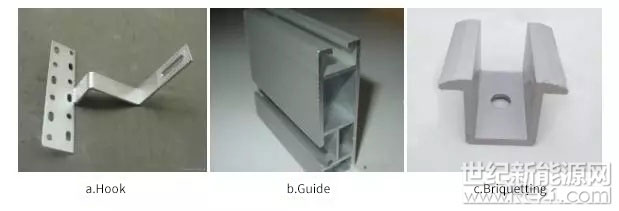
The tile roof installation system is mainly composed of hooks, guide rails, clamps and bolts.
2) Light steel roof installation system
Light steel roofs, also called color steel tile roofs, are mainly used in industrial plants and warehouses. According to the different forms of color steel tiles, they can be divided into angle-relaxed light steel roofs, vertical seaming steel roofs and ladder-shaped light steel roofs.
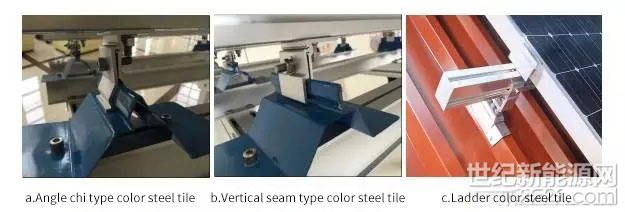
Angular relaxation type light steel roof and vertical seam type light steel roof mainly use clamps as connecting pieces to fix the guide rails on the roof, while the ladder-type light steel roof needs to use self-tapping bolts to fix the connecting pieces on the roof.
No matter what kind of roof form, when choosing the connector, it is necessary to measure the size of "angle relaxation", "upright side" and "trapezoid" on the spot to ensure that the connector matches the roof, and it is necessary to install the ladder-type light steel roof bracket. Take good waterproof measures to avoid water leakage at the bolt holes.
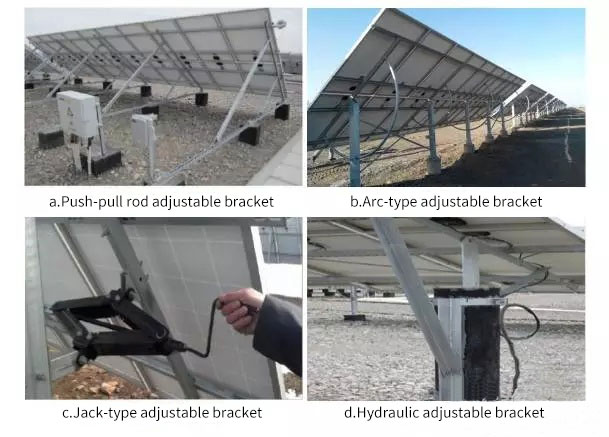
3. Adjustable fixed inclination
The fixed inclination adjustable type means that the inclination angle of the fixed bracket is regularly adjusted at the turning point of the sun's incident angle to increase the absorption of direct sunlight and increase the power generation capacity at a slight increase in cost.
Tracking photovoltaic support
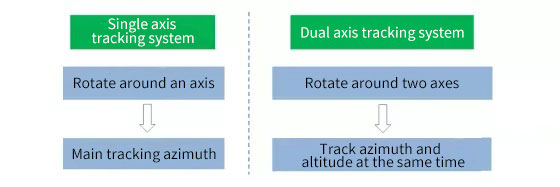
The tracking type photovoltaic bracket uses electromechanical or hydraulic devices to make the photovoltaic array move with the change of the sun's incident angle, so that the sunlight is as direct as possible to the module panel, and the power generation capacity of the photovoltaic array is improved. According to the number of tracking axes, it can be divided into: single-axis tracking system and dual-axis tracking system.
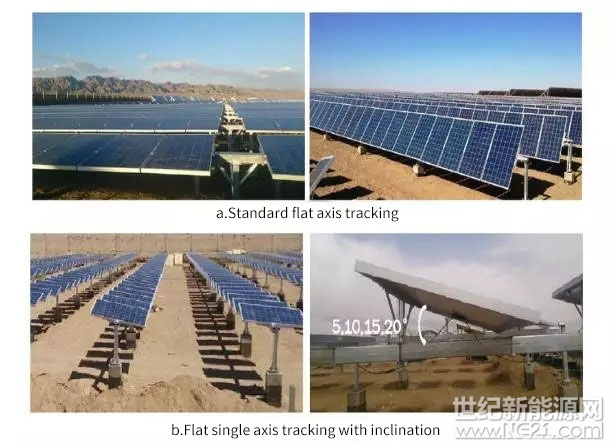
1. Flat single axis tracking system
The photovoltaic array can track the sun along a horizontal axis in the east-west direction to obtain a large amount of power generation and is widely used in low-latitude areas. According to whether there is an inclination in the north-south direction, it can be divided into a standard flat single-axis tracking type and a flat single-axis tracking type with an inclination angle.
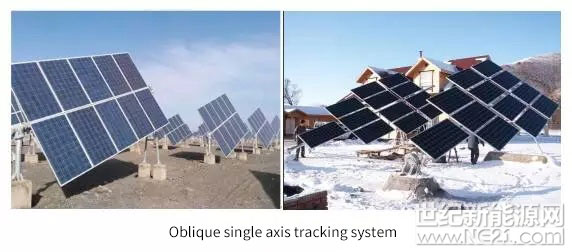
2. Oblique single axis tracking system
The tracking axis rotates in the east-west direction while setting a certain inclination to the south, and rotates around the tilt axis to track the azimuth of the sun to obtain greater power generation, which is suitable for higher latitude areas.
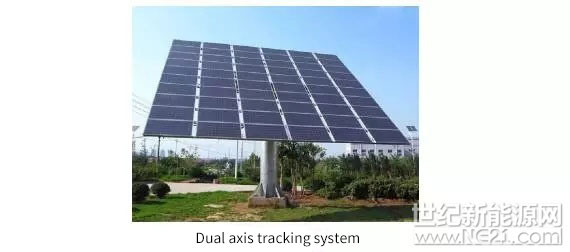
3. Two-axis tracking system
Two axis rotation (vertical axis, horizontal axis) are used to track the sun's rays in real time to ensure that the sun's rays are perpendicular to the panel surface of the module at every moment, so as to obtain the maximum power generation, which is suitable for use in various latitudes.
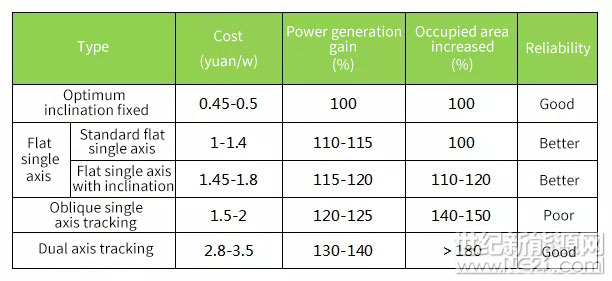
4. Comparison of several support operation modes
Comparison and selection of photovoltaic support steel and aluminum
Material strength
The bracket generally uses Q235B steel and aluminum alloy extruded 6063 T6. In terms of strength, 6063 T6 aluminum alloy is about 68%-69% of Q235 B steel. Therefore, steel is generally better than aluminum alloy in strong wind areas and large spans. Profile.
Deflection and deformation
The deflection and deformation of the structure are related to the shape and size of the profile and the elastic modulus (a parameter inherent to the material), but not directly related to the strength of the material.
Under the same conditions, the deformation of aluminum alloy profile is 2.9 times that of steel, and its weight is 35% of steel. In terms of cost, under the same weight, aluminum is 3 times that of steel. Therefore, steel is generally better than aluminum alloy profiles in areas with strong winds, relatively large spans, and cost.
Corrosion protection
At present, the main anti-corrosion method of the stent is hot-dip galvanized steel 55-80μm, and aluminum alloy is anodized 5-10μm.
Aluminum alloy is in the passivation zone in the atmospheric environment, and a dense oxide film is formed on its surface, which prevents the surface of the active aluminum matrix from contacting the surrounding atmosphere, so it has very good corrosion resistance, and the corrosion rate increases with time And reduce.
Under ordinary conditions (C1-C4 environment), the thickness of 80μm galvanized steel can be used for more than 20 years. However, the corrosion speed will increase in high-humidity industrial areas or high-salinity seashores or even temperate seawater. The amount of galvanization needs to be 100μm. The above and need regular maintenance every year.
Aluminum alloy is far superior to steel in terms of corrosion resistance.
Other aspects compared to anti-corrosion aspects
(1) Appearance:
There are many surface treatment methods for aluminum alloy profiles, such as anodizing, chemical polishing, fluorocarbon spraying, electrophoretic coating, etc. The appearance is beautiful and can adapt to a variety of strong corrosive environments.
For steel, hot-dip galvanizing, surface spraying, paint coating, etc. are generally used. The appearance is worse than that of aluminum alloy profiles. It is also inferior to aluminum profiles in terms of corrosion resistance.
(2) Cross-section diversity
The general processing methods of aluminum alloy profiles include extrusion, casting, bending, and stamping. Extrusion production is the current mainstream production method. By opening the extrusion die, any cross-section profile can be produced, and the production speed is relatively fast.
Steel materials generally adopt methods such as rolling, casting, bending, and stamping. At present, rolling is the mainstream production method for producing cold-formed steel. The cross section needs to be adjusted by a roller set, but the general machine can only produce similar products after finalizing the shape, and the size can be adjusted, and the cross-sectional shape cannot be changed, such as C-shaped steel, Z-shaped steel and other cross-sections. The rolling production method is relatively fixed and the production speed is relatively fast.
Material recycling
The maintenance cost of steel structure increases by 3% every year, while the support of aluminum structure hardly needs any maintenance and maintenance, and the recovery rate of aluminum material is still 65% after 30 years. The price of aluminum is expected to increase by 3% every year. After 30 years, it is basically a pile of scrap iron with no recycling value.
Comprehensive performance comparison
(1) Aluminum alloy profiles are light in weight, beautiful in appearance, and excellent in corrosion resistance. They are generally used in household roof power stations and strong corrosive environments that have requirements for load-bearing.
(2) The steel has high strength and small deflection and deformation when under load. It is generally used for ordinary power stations or for components with relatively large forces.
(3) Cost: In general, the basic wind pressure is 0.6kN/m2, the span is less than 2m, and the cost of the aluminum alloy bracket is 1.3-1.5 times that of the steel structure bracket. In the small-span system, the cost difference between aluminum alloy bracket and steel structure bracket (such as color steel plate roof) is relatively small, and aluminum alloy is much lighter than steel bracket in terms of weight, so it is very suitable for home roof power stations.